In layman’s terms, a Digital Twin is like a virtual version of a real-world object that behaves exactly like the real thing because it is fed with real data. The data help you to model the digital twin. More data, clean data, more efficient the digital twin is.
Here is a breakdown of what this means for your Pelton Wheel and your research.
Table of Contents
1. What exactly is a Digital Twin?
Imagine you have a twin brother. If you eat a sandwich, he feels full. If you run, he gets tired. In the world of machines, the Physical Twin is your Pelton Wheel in the lab, and the Digital Twin is a computer model that “feels” what the real turbine is doing.
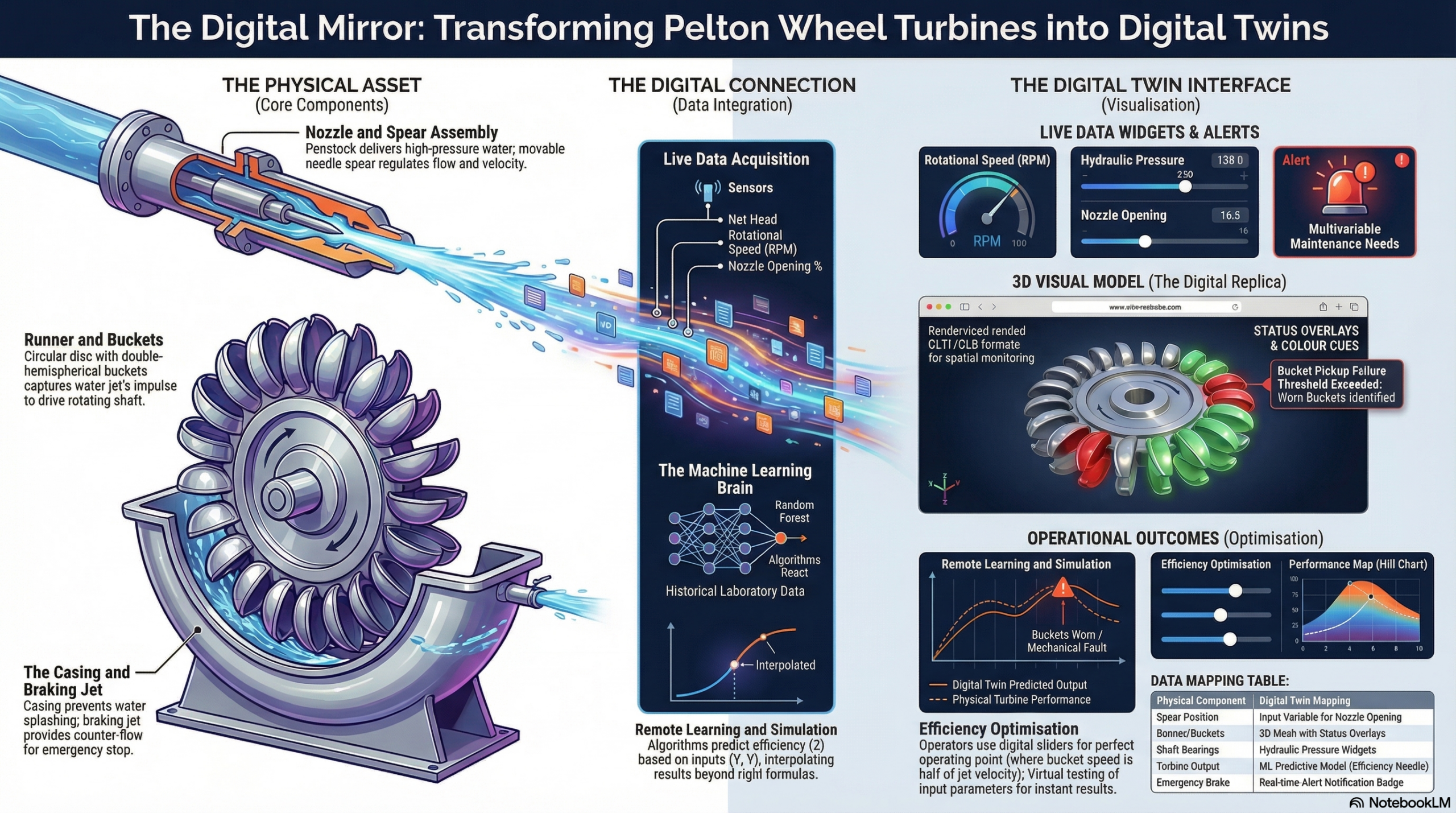
Creating a Digital Twin means: You are building a mathematical “brain” or model that can predict the turbine’s output (Efficiency) for any given input (Head, Speed, Nozzle Opening) without you having to actually turn on the machine.
2. Creating a Digital Twin for your Real World Machine
To build digital twin for your specific setup like Pelton Wheel, you don’t need a single “magic formula.” Instead, you need three things:
-
The Skeleton (Data): The real experimental data from laboratory experiments. This tells the computer, “When the Head was X and Speed was Y, the Efficiency was Z.”
-
The Brain (Machine Learning): You use an algorithm (like the Random Forest or any suitable one). This algorithm looks at your data and learns the patterns. It realizes that if the speed is too high, the water splashes and efficiency drops. The data speaks itself, taking care of physics also.
-
The Interface: A simple software screen where you can move sliders to change the “Head” or “Nozzle Opening” and see the “Efficiency” needle move instantly.
3. Is there a Formula?
In a Digital Twin, we move away from a single rigid formula like Efficiency = Input/output and move toward Data-Driven Functions.
Instead of you solving the math, the Machine Learning model creates a complex internal map. When you give it new inputs, it “interpolates” (guesses based on patterns) the result.
Layman Example:
-
Traditional Method: You use a calculator and a formula. If the formula is slightly wrong, your result is wrong.
-
Digital Twin Method: The computer looks at data you did it for real and says, “Based on every data of the lab, if you set the Head to 55m, the efficiency will be 82%.”
4. What do you need to “Create” to show a Digital Twin?
For “creating” the twin involves:
-
A Predictive Model: The saved Python code (model file) that can take any input and give an output. If you feed any input data like head, nozzle opening (must be within the range of the data you fed to the model) the model predicts the performance parameter like efficiency.
-
Performance Maps (Hill Charts): These are the “maps” the twin model generates to show where the turbine works best. You can run the real machine well within the optimized zone of the parameters.
Advantages of Digital Twin:
-
Remote Learning: The machine learning helps you to create a digital twin or virtual machine (Pelton wheel) that helps you to take any input parameters and gives you output parameters without actually running the machine in the laboratory.
-
Predictive Maintenance: You can show that if the real turbine starts performing worse in comparison to the Digital Twin, it means the buckets are worn out or there is a mechanical fault.
-
Efficiency Optimization: You can use the Twin to find the “Perfect Operating Point” much faster than a human could by trial and error.
Summary in one sentence:
Creating a Digital Twin means turning your Excel data into a “Virtual Turbine” that lives in your computer and can accurately predict how the real turbine will behave in any situation.