
A comprehensive guide to choosing, using, understanding, and avoiding problems with automotive engine oils.
The oil filter in any vehicle is the most useless engineering item. It is not “just lubricant” — it is a precisely designed fluid system designed to withstand shear forces, thermal cycling and the attack of chemicals and maintain metal surfaces microns apart under extreme loading. A complete breakdown of what tribology is, the standards, and the decisions made that can make an engine last 300,000 km versus 100,000 km.
Table of Contents
The Physics of Lubrication and Introduction.
All engine oil oil can serve five functions simultaneously: hydrodynamic lubrication (providing a complete oil film between moving parts, thus preventing metal to metal contact), cooling (carrying heat away from the piston skirts and bearings to the sump), sealing (preventing piston rings from coming into contact with metal, maintaining compression), cleaning (suspension of soot, varnish and wear debris by the oil until the filter or next oil change removes the dirt), and corrosion protection (neutralizing acidic by-products of combustion).
The oil’s ability to do this across a temperature range is captured in its SAE viscosity grade — for example, 5W-30 or 15W-40. The number before the “W” (Winter) indicates the cold-cranking viscosity (CCV): the lower the number, the better the oil will flow and remain pumpable on cold start-up, thereby minimising wear in the first few seconds of starting combustion. The figure following the “W” element indicates the viscosity of the oil at 100°C (operating temperature). A 5W-30 oil has a weight of 5 when it is cold, but it turns into a 30 weight oil when it is hot.
Under typical operating conditions there are two properties that determine how well an oil will retain this range:
Viscosity Index (VI): An estimate of the resistance of the oil to thinning due to higher temperature. The film strength of high-VI oil (typical of Group III/IV synthetics) will be maintained over a wide thermal range when compared to low-VI mineral oils.
What makes multigrade oils “multigrade” is the viscosity index improving (VII) polymers used to provide their wide operating range. These polymers can, over time, be mechanically sheared to a much lower grade, especially under high shear conditions (valve train contact, oil pump gears), causing them to lose protection even though they are budget-priced multigrades.
The second step in classification is to understand the labels. The second step in classification is to read the labels.
API Service Categories
Oils may be classified by the American Petroleum Institute (API) as either “S” (Spark-ignition or petrol) or “C” (Compression-ignition or diesel) service. API SP is the new highest-grade petrol grade, designed specifically to address the problem of Low-Speed Pre-Ignition (LSPI) in the modern turbocharged direct-injection engines, replacing API SN. API CK-4 and FA-4 are the current categories for heavy duty diesel; while backward-compatible with older engines, the FA-4 category represents a lower viscosity, fuel economy focused oil which has not necessarily been approved by all OEMs and is not necessarily backward compatible.
The key note speaker will be a representative from ACEA Sequences (European Standard).
ACEA classifications are even more rigorous in the European market:
A/B sequences are for light duty diesel and petrol passenger cars.
C sequences are especially designed as “low-SAPS” or “low” oils (Sulfated Ash, Phosphorus, Sulfur) to safeguard Diesel Particulate Filters (DPF) and Gasoline Particulate Filters (GPF) from ash-clogging (required on most Euro 6 vehicles).
Heavy duty diesel engines, which are used in trucks and buses, are addressed by E sequences.
The Japanese motorcycle and automotive societies have compiled standards that are known as JASO Standards (Japanese, Motorcycle-Specific).
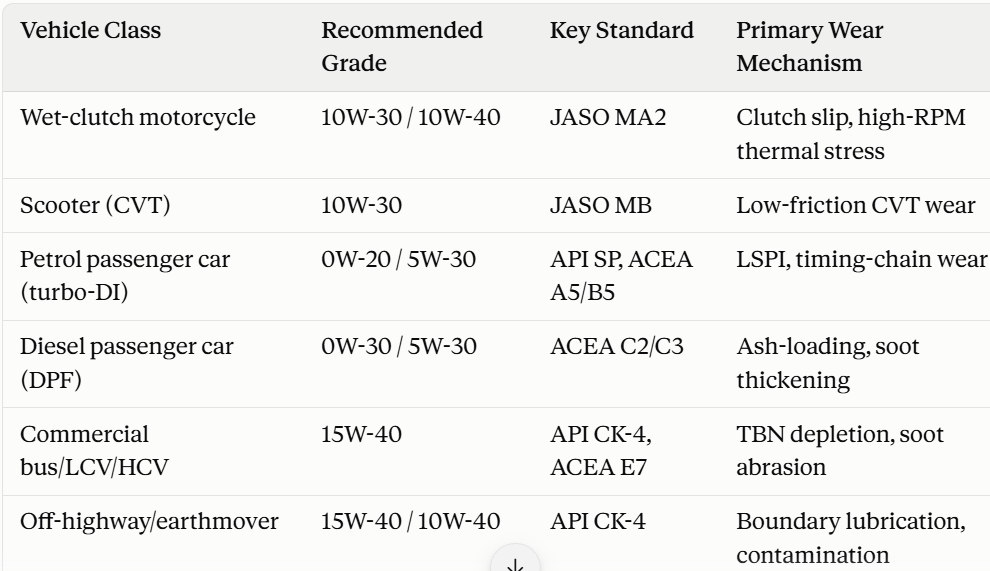
This is where there is a difference between oils for cars and bikes. JASO MA/MA2 oils have controlled friction modifiers to ensure wet-clutch engagement on geared motorcycles—Do not use a car-spec oil with friction modifiers (most API SN/SP passenger car oils) on a bike intended for wet-clutch applications because clutch slip will result. JASO MB is to be used on dry clutch or clutch-less scooters (CVT), where low friction is actually desired for fuel economy. One of the most often made and avoidable maintenance errors committal made by two wheeler owners is use of the incorrect JASO spec.
This is a segment-by-segment guide to selecting engine oils. Two-Wheelers (Bikes & Scooters)
Unlike cars, wet-clutch motorcycles have the oil circulate through the engine, gearbox and clutch pack. This requires that the oil perform dual functions of high thermal stability, acceptable clutch grip characteristics and has to be effective in handling the high thermal loading caused by compact high-revving engines. JASO MA2 is the higher level of friction performance for sportier bikes with higher clutch loads, MA is the lower level. Scooters with CVT and Dry Clutch focus on fuel efficiency, using JASO MB.
New passenger cars (petrol, diesel, hybrid)
The global trend is toward ultra-low viscosity grades (0W-16 and 0W-20) for improved fuel economy requirements and tighter manufacturing tolerances. These thin oils have low internal pumping losses, but require excellent film strength at operating temperature – hence almost all of these oils are full-synthetic (Group IV/V). Prevention of LSPI is now an integral part of the design of petrol turbo-DI engines; API SP-rated oils include calcium-based additive packages that are optimised to inhibit LSPI events. For petrol and diesel vehicles equipped with an SCR or DPF catalyst, it’s equally important as oil viscosity — oil with a high SAPS will cause the DPF catalyst to load up with ash faster, regardless of oil brand “premium”!
Commercial Transport (Buses & LCVs/HCVs)
Oil that has been optimised to extend drain intervals and to retain Total Base Number (TBN) is oil that still has the ability to neutralise the acidic combustion byproducts. The more TBN is used up, the faster corrosive wear occurs. This is where soot dispersion additive packages are essential because commercial diesels emit much more soot than passenger cars, and inadequate soot control results in increased oil thickening and clogging of the filters well before the scheduled drain.
Heavy-Duty & Off-Highway (Earthmovers, Mining & Construction Equipment)
Applications are operated under conditions of extreme pressure and high shear loads, and are highly contaminated with particulates from the operating environment. The concentration of anti-wear additives (AWAs) in automotive fluids is usually lower than in those used for gear sets and hydraulic components, particularly when operating in boundary lubrication mode, to protect the hydraulic components, which is why zinc dialkyldithiophosphate (ZDDP) is present in higher concentrations. Thermal degradation is not always the limiting factor; particulate ingress control, from the additive package dispersion and from filtration, is often the limiting factor in these applications.
Brand Landscape & Cost-to-Performance Analysis
There are typically three types of global brands. Premium full-synthetic (Mobil 1, Motul, Liqui Moly top-tier lines) have the best shear stability and oxidation resistance and it is these characteristics that are most beneficial in high-performance or extended-interval applications. Synthetic blends (mid-range Castrol GTX, Shell Helix HX7) consist of Group III synthetic base stock and conventional oil and offer a truly logical compromise for regular use between the two extremes, when OEM guidelines are being followed. Fleet-grade mineral oils (Shell Rimula base range, TotalEnergies commercial lines) are still suitable for older, lower tolerance diesel engines on shorter, well-managed cycles where the extended drain benefits of synthetic oils are not being taken full advantage of.
This is where a well-chosen set up pays off for anyone who actually does the work of making a proper maintenance kit consisting of dipsticks, funnel kits, filter wrenches, and oil analysis kits in order to detect TBN and wear-metal trends rather than making educated guesses: [Check on Mechanical Duniya Amazon Storefront].
Rules of Thumb & Vehicle Maintenance Best Practices are provided.
Consider ambient operating temperatures, not OEM default — an engine will run fine if it is constantly operated in extreme heat, it might need the higher end of the OEM-rated viscosity range while an engine that is operated in cold conditions might require the lower “W” number to insure starting-up. With aging engines, and as clearances increase slightly, a slightly higher viscosity within the approved range may be beneficial to maintain film strength, but will not be done at the expense of an OEM specification.
The distance is not the only factor used to determine drain intervals. Any short city trips that involve frequent cold starts, stop and go traffic and dusty conditions should be considered “severe service” and should have intervals much shorter than the highway cycle quoted in the owner’s manual.
The oil filter is not a piece of “optional” equipment, it’s half the lubrication system. Filter micron rating is the size of the particle that will be filtered before it contacts bearing surfaces, and the bypass valve will insure that oil will flow around a clogged filter at the expense of the unfiltered oil. Changing the oil without changing the filter circulates the very dirt and grime the filter was designed to remove — a wasteful practice that doesn’t make much sense. Every DIY kit should have a good filter wrench and quality replacement filter: [Check on Mechanical Duniya Amazon Storefront].
When checking the oil level correctly: The engine should be at normal operating temperature (or per OEM spec, cold — check your manual as this varies), the vehicle on level ground, and the engine off for several minutes to allow the oil to drain back to the sump — the level will be falsely low if it is checked right after the engine stops. A proper dipstick and funnel kit eliminates the confusion of home-grown solutions: Check on Mechanical Duniya Amazon Storefront.
Myths vs. Engineering Reality
Myth #1: “Black oil is a time bomb waiting to go off.Myth #1: When oil turns black, it must be replaced. Darkening is at least detergent additives working as they are supposed to; holding soot and combustion byproducts that would otherwise fall out or stick to the inside of the furnace. The true degradation indicators are TBN, viscosity retention and wear metals, which are measured by an oil analysis kit.
Myth 2: “Thicker oil will always be more protective. Excessive viscosity results in higher internal friction, higher pumping losses and can decrease the penetration of films into tight clearances during cold start, just when they are needed most; and thus exacerbate wear. Manufacturers’ recommended viscosity represents designed clearances and increasing it to be “safe” is a widespread, incorrect practice.
Myth #3: “If you use a synthetic, you can’t use a mineral again. This is a myth, and there is no chemical evidence to support it. Modern synthetic and mineral oils are completely solvent with each other and compatible with all the same types of seals and can be changed in either sequence. The confusion was probably the result of the old, less successful synthetics not long ago.
Myth 4: “Engine oil additives and flush chemicals are required for each oil change. Existing formulated oils have a well-balanced additive package, and after-market additives can upset the balance or interact in an unknown way with the built-in detergents or anti-wear agents. Chemicals which are used to flush should be used for specific situations, such as after considerable sludge formation or prior to a fluid type change, not as a regular practice.
Tribological Failures: Diagnosis & Prevention
Oil that is taken through the length of its useful oxidative life, usually due to extended oil-draining or prolonged operating life at high temperatures, will cause thermal breakdown and sludge formation, which will narrow oil galleries and dry out bearings.
Fuel dilution and coolant contamination are different; in the case of fuel dilution (typically with short trip petrol engines and some DPF regeneration cycles) the oil becomes thinner and this affects the film strength, whereas in the case of coolant contamination, it appears milky and emulsified, and this is likely to be a head gasket or oil cooler seal leak, and will need to be addressed, not just an oil change.
Boundary lubrication failure and journal bearing scuffing occurs when the hydrodynamic oil film fails under high load and/or oil starvation conditions, enabling metal-to-metal contact which is what ZDDP anti-wear additives are designed to prevent by creating a sacrificial protective layer.
The lower quality of multigrade oils compared to shear-stable, synthetic high-grade oils, is one of the reasons these latter types of oils are superior for track-driven or high-load applications: the viscosity shearing caused by sustained high RPM or loadings will permanently lower the viscosity index improving polymers, which will consequently drop the oil below its rated viscosity.
8. Conclusion & Pre-Drive Checklist
Choosing engine oil is no matter of guesswork, but a matter of engineering, in which viscosity physics, additive chemistry and duty cycle all play a role. Prior to your next service use this checklist:
Ensure you get a viscosity grade and API/ACEA/JASO rating that matches your vehicle exactly as specified by the OEM.
Be aware of the severity of your duty, and match the drain interval to that duty.
Replace the oil and oil filter—NEVER one without the other.
Check oil level on level ground, engine settled, at temp spec, per manufacturer’s manual
If you see a milky colour (coolant) or a strong fuel smell, this is a big red flag and not a normal oil colour, so please watch out for these.
Use an oil analysis kit to check TBN and wear metal trends rather than by sight; do so periodically: [Check on Mechanical Duniya Amazon Storefront]
Properly maintain these basics and engine oil finally becomes the most budget-friendly policy your car’s engine carries.